
How to Stand Out in a Crowded Market on Your Terms
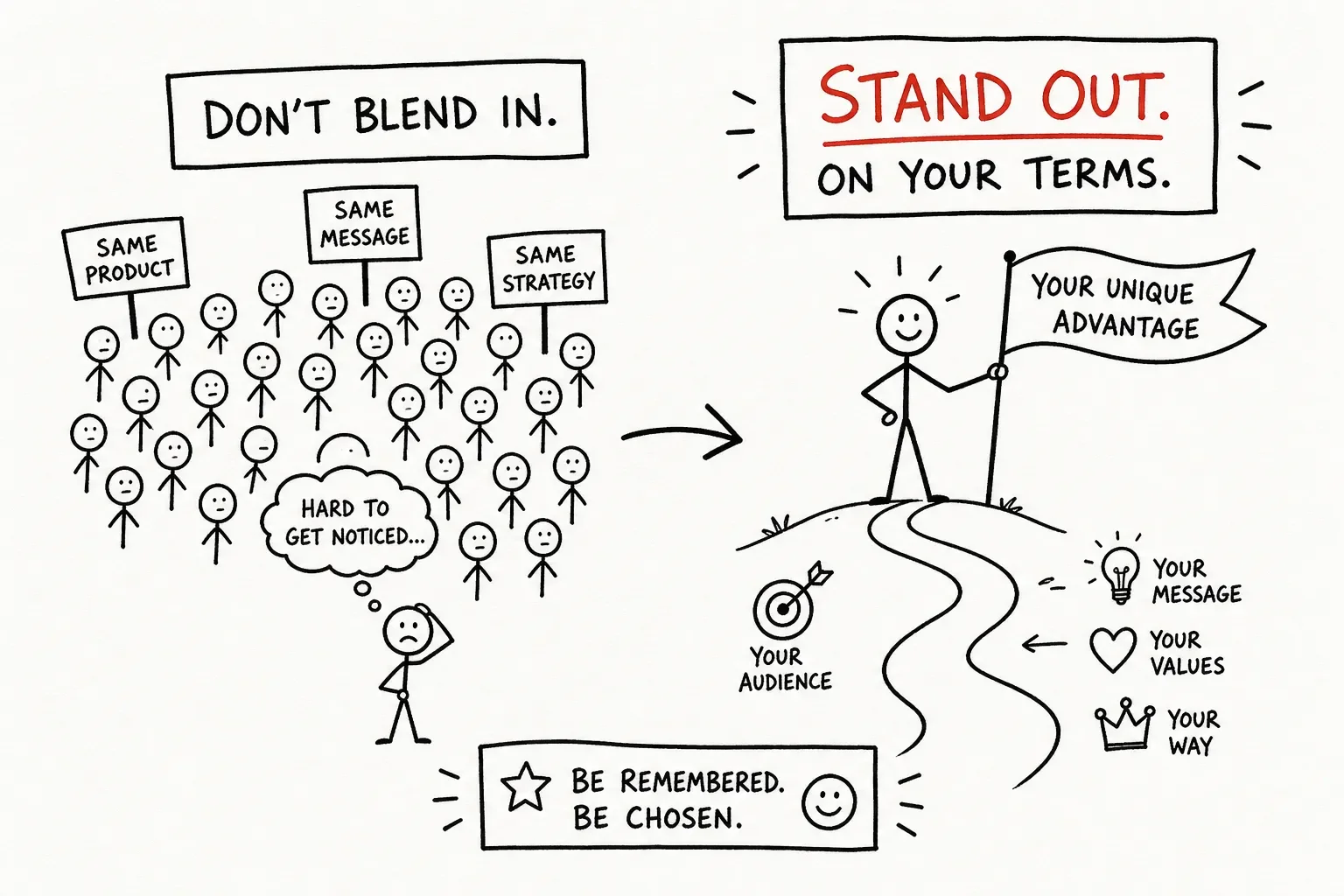
A lot of business owners trying to stand out are solving the wrong problem. They add another platform. They try a rebrand. They post more content. Then they wonder why nothing changes.
The issue isn't effort. The issue is that no one can explain what makes them different. Sometimes not even the owner.
I see this all the time working with coaches, consultants, and solopreneurs who are genuinely skilled but feel overlooked. The root cause is usually the same. They went looking for visibility before they had clarity. They tried to get seen before they got specific.
The fix isn't more tactics. It's a sharper, truer story about who you're for and what you do differently. Getting clear on that, and staying consistent about it, is what lets the right people recognize you right away.
Why most differentiation advice keeps you invisible
Most advice on standing out defaults to execution. Post more. Optimize your funnel. Run ads. Try a new format. None of that is wrong exactly. It's just too early.
Without a clear foundation under your positioning, more activity just makes more noise. You end up spending energy amplifying a message that doesn't land yet.
Doing more never fixes a clarity problem. I get into why that pattern shows up so often in Why Common Marketing Advice Smothers Your Momentum (And What to Do Instead).
Copying other companies who are visible in the market is its own trap. You end up looking like everyone else, only slightly different. That's a race to the middle, and the market doesn't pay for that.
Businesses that cut through noise rarely find some less competitive space to hide in. They find a more specific customer inside a competitive market.
Dollar Shave Club didn't invent the razor. Mailchimp didn't invent email marketing. Both found a customer who was overserved by what already existed. And gave them something simpler and more direct.
A crowded market is proof there's real demand. Competition isn't the problem. Sameness is.
Niche clarity: how to stand out in a crowded market
Define your niche to break through the noise
A niche isn't a demographic. It's a specific problem, a specific person, and a specific outcome you're positioned to deliver better than most.
A lot of business owners avoid niching down because they're worried about shrinking their pool of clients. I get the worry, but it works backward. Without a clear niche, you're invisible to the people who'd pay the most for exactly what you offer.
Tighter, niche-focused positioning tends to lower customer acquisition costs and improve conversion, though results vary by industry and execution. When your message matches what your best clients are already searching for, you stop wasting energy on leads who were never the right fit.
Niche diagnostics and outcomes
Two questions tend to expose your real positioning gap. Who loses the most when your business doesn't exist? And what are they doing instead? That means what are they doing right now to solve the problem without you.
Those two questions point straight at your target customer and your real competitive alternative. That's the starting point for any Clarify work. For service businesses, the alternative usually isn't a direct competitor. It's inertia. It's a generalist. It's the client trying to handle it themselves. Knowing that shifts how you talk about what you do.
Positioning that only you can own
When every coach, consultant, and service provider describes themselves by category, clients can't tell them apart. Business coach. Marketing consultant. Leadership strategist. Those labels describe a market. They don't describe a position inside it. The real differentiator isn't what you do. It's how you do it and why, grounded in your values, your method, and the lens you bring to the work.
The strongest positioning I've seen comes from people building around their actual strengths instead of borrowing what's working for someone else. What's working for that other person is working because it fits them. Borrowed positioning feels thin because it is. Your job is to own a space shaped by who you actually are and the audience you’re called to serve.
That's the whole idea behind Strengths-First Marketing. Clarify who you're for and what makes you different. Simplify your message until someone who just met you could repeat it back. Amplify through the channels that match how you actually work. It's built around your strengths, which is exactly why it holds up.
Writing a one-sentence unique value proposition that actually holds up
A good unique value proposition, or UVP, forces a hard choice. I usually start with a simple structure. [You] help [who] [do what] so they [get what benefit or experience what transformation]. That's the ten-second version, the kind you'd use if someone asked what you do at a networking event.
Sometimes it helps to lead with the problem first, then land on that same structure. Many [target market] struggle with [the problem], which causes [symptom or pain]. From there you move into the same shape. [You] help [who] [do what] so they [get what benefit or experience what transformation]. Starting with the problem tends to earn attention before you even get to what you offer.
Neither version is the only right way to do it. You can mix and match depending on the room you're in and the story you're telling. What matters is that every piece pulls its weight. Your "who" needs to be specific enough that not everyone qualifies. Your "problem" should be one your ideal client would recognize immediately in their own words, not a vague pain point. Your "transformation" has to be something real, not just a feature dressed up as a benefit.
The most common mistake is writing a statement that describes your category instead of your position in it. "I help businesses grow through strategic marketing" describes almost every marketing consultant alive. That's a category statement, not a differentiator. Write three or four versions before you settle on one. The discomfort of choosing is kind of the point.
Your UVP only works if someone outside your head gets it instantly. Share it with a few people outside your industry and ask two questions. Who do you think I help? Why would someone hire me over someone else? If their answers don't match what you meant, the language needs work. That feedback loop is fast, free, and honestly more useful than early analytics when you're testing for clarity.
How the client experience helps you stand out in a crowded market
Standing out through client experience isn't about piling on perks. It's about consistency. How you communicate before a project starts. How clear your onboarding is. How you follow up once the work is done. Those details are part of your positioning whether you plan them that way or not.
Research from Salesforce's State of the Connected Customer report has repeatedly shown that a majority of buyers will pay more for a better service experience. I'd treat the exact number as a moving target since it shifts by year and report edition, but the direction has held for a long time: client experience is a driver of what people will pay, not just a retention tactic.
The experience of working with you should match the promise in your positioning. If your message says you're a calm, clear-headed guide for overwhelmed business owners, your onboarding should feel that way too. When what you say and what you do don't match, it undercuts the differentiation you worked to build.
Word of mouth is still one of the highest-converting channels for service businesses. And I'd expect niche-focused businesses to see stronger referral rates than broader competitors. Mostly because clients in a tighter network can describe what you do to people with the same problem.
When your positioning is clear and your client experience backs it up, referrals happen on their own. Clients have something specific to say about you. That's what the Amplify phase of Strengths-First Marketing is built around. Clear positioning earns referrals because it gives your clients the words to use.
A 90-day test to find out if your positioning is working
Start with three things in the first month. Finalize your niche. Draft your one-sentence UVP, your unique value proposition. Audit your current messaging to find the gap between what you're saying and what you actually mean. This isn't a rebrand. It's a clarity check. Set a baseline too, something like how many qualified conversations you're having a month, so you have a real number to measure against later.
By day 60 to 90, the early signs usually aren't traffic or revenue. They're recognition. Prospects start describing your business back to you accurately. Referrals get more specific. You stop hearing from people who were never a fit in the first place. Those are the signs your differentiation is starting to hold, well before the numbers catch up.
Pay attention to the qualitative signals too, not just the numbers. When someone tells you a friend said you're the person to call for exactly this, that's your positioning doing its job. That moment matters even before the revenue shows up.
Clarity is the competitive advantage most businesses skip
You don't need to get louder. You need to get clearer. Standing out in a crowded market has less to do with outspending or out-hustling everyone else and more to do with saying something true that only you can claim. The businesses that break through aren't always the most visible ones. They're usually the ones who took the time to figure out exactly who they're for.
Three moves you can make this week. Define your niche down to one specific person with one specific problem. Draft your positioning statement (UVP) using one of those formulas and test it on a few people outside your industry. Pick one part of your client experience and sharpen it. None of these are big moves. They're just precise ones.
The market doesn't reward volume. It rewards specificity. When you stop trying to be everything to everyone and get clear about who you serve and why, you stop competing for attention and start attracting the right people. That's how small, values-driven businesses stand out in a crowded market. Not by doing more. By becoming undeniably themselves.
For more resources and practical tips on how to stand out, check out our other posts on this topic.